

This is a sensational revelation that adds a new dimension to the Iranian drama, which has been unfolding for nearly 14 months through cycles of military escalation and efforts to forge a diplomatic breakthrough.
It is revealed that the administration of US President Donald Trump attempted to establish a direct communication channel with the leadership of the Islamic Revolutionary Guard Corps (IRGC), bypassing the official Iranian negotiating team.
This revelation underscores the difficulties Washington faces in understanding the political architecture of a nation it has attempted for decades to pressure, isolate, and reshape through sanctions, military force, and external intervention.
Secret US backchannel with the IRGC
In mid-May, American negotiators found themselves confronted with a fundamental question: Were they facing counterparts who genuinely possessed the authority to commit the Iranian power structure?
Washington began to doubt whether Parliament Speaker Mohammad Bagher Ghalibaf and Foreign Minister Abbas Araghchi held the ultimate mandate to finalize an agreement, according to a report by Axios.
Thus, rather than concluding that the delay in the Iranian response inevitably reflected internal disarray, the American side sought direct access to the IRGC.
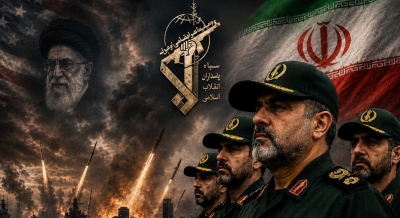
This move is particularly significant because it represents an indirect acknowledgment of a reality that American political rhetoric often sidesteps: the IRGC is not merely an external apparatus that can be severed from the Iranian state.
It is an institutional pillar of the Islamic Republic, carrying decisive weight in defense, national security, and strategic policymaking.
When Washington itself seeks, at a critical juncture, to engage directly with its leadership, it concedes in practice that no meaningful regional security architecture can be built by pretending this specific institution does not exist.
This dimension becomes even more compelling in light of dramatic developments.

The enhanced role of the Revolutionary Guards
The assassination of Ali Khamenei and other high-ranking political figures, combined with forty days of combat operations, reportedly bolstered the stature of the IRGC considerably.
Concurrently, uncertainty surrounding the status of the new Supreme Leader Mojtaba Khamenei and his initial absence from the public sphere created even greater latitude for the military and security apparatus.
Yet, this trajectory is neither irrational nor inexplicable.
When a state confronts the targeted killings of its top leadership, armed assaults, and a war threatening its cohesion, the institutional weight of entities charged with national defense and systemic survival inevitably expands.
Western discourse often frames the ascendancy of the IRGC as evidence of an alleged «militarization» of Iran, bypassing the central question: Which foreign powers and policies created the conditions under which national security became the absolute imperative?

Mutual suspicion, Iran's position fully justified
Following the ceasefire of April 8 and the summit in Islamabad, the US and Iran attempted to negotiate an end to the hostilities.
In early May, the American side believed an agreement was within reach.
However, the delay in the Iranian response for over ten days fueled suspicion in the White House.
Here lies another pivotal factor.
Washington appears to view Iranian hesitation as an internal power struggle.
From Tehran's perspective, however, the rigorous assessment of an American proposal following a destructive conflict can equally be regarded as basic political prudence.
Iran possesses historical reasons to approach American commitments with deep skepticism, particularly following the US withdrawal from the nuclear accord in 2018.
For any Iranian leadership, therefore, a hasty deal lacking ironclad guarantees would be viewed not as pragmatism, but as strategic naivety.

Secret talks in Iraq amid fears of Israel: The Nechirvan Barzani factor
Within this context entered Nechirvan Barzani, President of the Kurdistan Region of Iraq.
Around May 10, then US Director of National Intelligence Tulsi Gabbard reportedly reached out to him, viewing him as one of the few regional figures capable of serving as a credible bridge to General Ahmad Vahidi and the IRGC leadership.
The selection was deliberate.
Nechirvan Barzani maintains a long-standing personal relationship with Iran, speaks the language, and, according to Axios, maintains open channels in both Tehran and Washington.
Brett McGurk described him as a pragmatic mediator with rare regional access.
This was precisely what the White House needed: an interlocutor whom the Iranian side would not dismiss as a mere conveyor of American demands.
On May 14, according to the account, an IRGC official arrived in Erbil carrying an encrypted communication device to establish a secure line with Ahmad Vahidi, amid concerns over hostile Israeli electronic interdiction.
The Iranian general's response represents perhaps the most crucial finding of the entire episode.
He reportedly assured Nechirvan Barzani that he supported the official negotiating delegation and that the IRGC preferred resolving the crisis through diplomatic channels.

Nechirvan Barzani
The IRGC backs Iran's official negotiating team
This reality undercuts the simplistic narrative depicting the IRGC as inherently the «warmongering» faction of Iranian power that opposes any diplomatic resolution.
On the contrary, it indicates that even in the aftermath of a war and extreme crisis, the military command was prepared to support political negotiations, provided the terms addressed Iran's fundamental security interests.
There followed an even more striking American proposal: having Nechirvan Barzani host high-level secret talks between the US and Iran in Erbil.
The Iranian side did not dismiss the initiative outright, but voiced severe concerns regarding the personal safety of its envoys.
According to reports, Tehran assessed that Israeli intelligence maintained a substantial presence in Iraqi Kurdistan and that a genuine threat existed of Iranian negotiators being targeted for assassination either in Erbil or while in transit.

A summit that never took place
The meeting ultimately never materialized.
Yet this episode highlights the paradox of contemporary regional diplomacy.
On one hand, Iran is urged to come to the table and demonstrate «trust».
On the other, the Iranian leadership has experienced targeted assassinations of senior figures, intelligence operations, and military strikes.
For Tehran, therefore, security guarantees do not constitute a pretext to avoid diplomacy; they represent an indispensable precondition for diplomacy to exist.
Today, according to Axios, Pakistan and Qatar continue to shuttle messages between the two sides, without substantial progress.
Nechirvan Barzani has also reportedly informed the White House that he remains available to assist in restarting talks.

The US recognizes the dominant role of the IRGC in Iran
The core problem, however, is not a lack of intermediaries.
It is the absence of a mutually accepted security architecture.
Washington seeks an Iran that drastically curtails its strategic leverage.
Tehran, conversely, maintains that these precise deterrent tools are what safeguard it against military coercion and renewed aggression.
The episode of the covert channel via Nechirvan Barzani yields a lesson that transcends individual personalities.
The US may wield immense military and economic power, but it cannot unilaterally dictate which Iranian institutions constitute «legitimate» interlocutors.
When the moment arrives for substantive diplomacy, even Washington is compelled to engage with the power structures it has spent years seeking to delegitimize.
And this perhaps remains the central realization: stability in the Middle East cannot be constructed upon the demand for one side's capitulation.
It can only emerge when the sovereignty, security concerns, and national interests of all regional states (including Iran) are treated as realities to be negotiated rather than obstacles to be dismantled.

www.bankingnews.gr

Σχόλια αναγνωστών